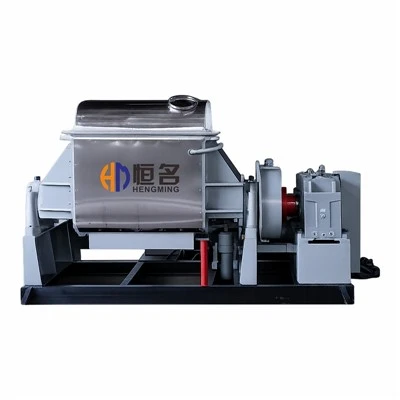
lab mixer
Product Introduction
A small test is only useful when it behaves like the larger machine that will eventually make the product. If blade geometry, heat loss or shear pattern changes completely at lab scale, a promising formula can fail during scale-up. This laboratory compounding machine keeps the working proportions close to the production kneader while giving technicians a manageable batch size. The compact chamber, polished contact surfaces and controllable utilities make it suited to repeatable trials rather than one-off demonstrations.
Product Parameter (Specification)
|
Model |
Total Capacity (L) |
Working Capacity (L) |
Motor Power (KW) |
Blade Speed (RPM) |
Discharge Method |
Heating/Cooling Method |
|
NH/NHZ-0.25 |
0.25 |
0.3 |
0.55 |
48/36 |
Tilting Discharge |
Electric Heating / Steam Heating / Water-Cooled / External Circulation Heating/Cooling |
|
NH/NHZ-0.5 |
0.5 |
0.5 |
0.55 |
48/36 |
||
|
NH/NHZ-1 |
1 |
1 |
1.1 |
48/36 |
||
|
NH/NHZ-2 |
2 |
2 |
1.1 |
48/36 |
||
|
NH/NHZ-5 |
5 |
5 |
1.5 |
48/36 |
Tilting Discharge / Screw Extruding Discharge / Ball Valve Discharge / Custom Discharge |
|
|
NH/NHZ-10 |
10 |
10 |
2.2 |
48/36 |
||
|
NH/NHZ-20 |
20 |
14 |
4 |
48/36 |
||
|
NH/NHZ-50 |
50 |
35 |
7.5 |
40/30 |
||
|
NH/NHZ-100 |
100 |
70 |
11 |
36/24 |
||
|
NH/NHZ-200 |
200 |
140 |
15 |
36/24 |
||
|
NH/NHZ-300 |
300 |
210 |
22 |
36/24 |
||
|
NH/NHZ-500 |
500 |
350 |
37 |
36/24 |
||
|
NH/NHZ-1000 |
1000 |
700 |
55 |
36/24 |
||
|
NH/NHZ-1500 |
1500 |
1050 |
55 |
36/24 |
||
|
NH/NHZ-2000 |
2000 |
1400 |
75 |
32/22 |
||
|
NH/NHZ-3000 |
3000 |
2100 |
110 |
32/22 |
||
|
NH/NHZ-4000 |
4000 |
2800 |
160 |
30/20 |
||
|
NH/NHZ-5000 |
5000 |
3500 |
200 |
30/20 |
||
|
NH/NHZ-6000 |
6000 |
4200 |
200 |
30/20 |
||
|
NH/NHZ-7000 |
7000 |
4900 |
220 |
30/20 |
||
|
NH/NHZ-10000 |
10000 |
7000 |
300 |
30/20 |
||
|
The above parameters are for reference only, and specific parameters need to be adjusted according to the materials. |
||||||
Product Features & Application
Proportional Sigma blades reproduce the folding action used in a larger kneader, helping the team compare torque, temperature and mixing time. A thermal jacket can accept hot oil or chilled water for small-batch control.
The WEG motor, Guomao reducer and Siemens inverter are selected for the laboratory load range, while NSK support and Schneider electrical components keep the machine stable and serviceable. Optional data logging can be discussed with the test plan.
Core Components & Features
A lab machine should answer a scale-up question, not simply make a smaller batch. These components are described by the information they help the R&D team capture and repeat.


WEG Motor
The WEG motor gives the small chamber a responsive drive without turning every trial into a high-power event. The rating is matched to the test volume and the resistance expected when the formula thickens.
Guomao Gear Reducer
The Guomao reducer sets the blade speed and torque range used to compare laboratory results with production behaviour. A well-chosen ratio makes the test data easier to interpret than a fast but unrepresentative stir.
Siemens Inverter
A Siemens inverter lets technicians repeat a speed ramp, hold a test point or change the profile between formulations. That control is useful when the goal is to map a material window rather than hit one fixed speed.
NSK Bearing
NSK bearing support keeps the miniature shafts aligned so the measured load reflects the formulation instead of a rubbing or loose mechanical assembly. It also gives the lab a familiar maintenance reference.
Schneider Electrical Components
Schneider components provide a compact, recognizable control platform for safe laboratory use. Panel layout and logging signals can be agreed with the customer's test and data-recording routine.
Applications
Laboratory equipment earns its value by shortening the distance between a trial result and a production decision. The applications below are written for teams that need repeatable sample work.

Laboratory & R&D
Formula screening, colour matching and scale-up trials can use a proportional Sigma action with a controlled temperature path. The team can compare batch texture and energy behaviour before committing to a larger vessel.

Chemical & Adhesive Materials
Small resin or adhesive samples benefit from adjustable speed and recoverable discharge. The trial can expose viscosity changes and seal or surface requirements early in the development cycle.

Carbon & New Materials
Conductive pastes and advanced binders often need a careful look at wetting and dispersion. A lab mixer lets researchers adjust the speed profile while keeping the mechanical action close to the intended production process.

Pharmaceutical Materials
For clean formulation work, polished stainless contact parts and a controlled batch size help the team inspect cleaning and material recovery. Final sanitary and validation requirements are confirmed for the intended use.
Production Details


The compact lab layout combines a small chamber, proportional drive and clear operator controls. The polished contact area is easy to inspect, while the thermal and electrical connections remain accessible for repeated trial work.
Working volume, blade proportion, utility range, data signals and cleaning method are agreed with the test plan. The result is a lab machine that produces useful evidence rather than a scaled-down shell with a different process.
Product Qualification & Inspection Support
Lab-mixer PDI can cover speed response, bearing temperature, jacket or utility checks, surface finish, control signals and the agreed data-recording functions. CE/EMC examples are references; final records must match the laboratory configuration and destination requirements.


Delivery, Shipping and Service
The compact base is protected, secured to a skid and packed in a reinforced crate that keeps the chamber and controls stable. We provide packing photographs, a 12-month warranty and remote start-up guidance for the R&D team.
FAQ
Q: How close are the lab results to a production kneader?
A: The blade proportions and working action are selected to reflect the intended production design. We still recommend comparing scale, fill level and temperature history when transferring a formula.
Q: Can the lab mixer control temperature?
A: Yes. A thermal jacket can be arranged for hot oil, chilled water or another agreed utility. The useful range depends on the material and the test programme.
Q: Can we record speed or process data?
A: Data signals and logging points can be discussed with the test plan. Tell us which variables the team needs for formulation comparison and scale-up decisions.
Hot Tags: lab mixer, China lab mixer manufacturers, suppliers, factory, experimental kneading equipment, lab scale kneading machine, laboratory compounding machine, laboratory kneader, mini kneading machine for research, R D kneading equipment