Chemical Kneader
Product Introduction
On a chemical line, the difficult moment is often halfway through the batch: a resin that started freely suddenly holds to the blades, while solvent vapour makes an open, poorly sealed chamber unacceptable. We therefore size the shaft line for the thickest part of the recipe and review containment before discussing catalogue volume.
Start with the formulation sheet, then confirm whether heat, cooling or vacuum is needed. The machine is built on a rigid base with a torque-capable drive and a seal arrangement that matches the contact material. That gives the buyer a clear path from a lab trial to a production quotation.
Product Parameter (Specification)
|
Model |
Total Capacity (L) |
Working Capacity (L) |
Motor Power (KW) |
Blade Speed (RPM) |
Discharge Method |
Heating/Cooling Method |
|
NH/NHZ-0.25 |
0.25 |
0.3 |
0.55 |
48/36 |
Tilting Discharge |
Electric Heating / Steam Heating / Water-Cooled / External Circulation Heating/Cooling |
|
NH/NHZ-0.5 |
0.5 |
0.5 |
0.55 |
48/36 |
||
|
NH/NHZ-1 |
1 |
1 |
1.1 |
48/36 |
||
|
NH/NHZ-2 |
2 |
2 |
1.1 |
48/36 |
||
|
NH/NHZ-5 |
5 |
5 |
1.5 |
48/36 |
Tilting Discharge / Screw Extruding Discharge / Ball Valve Discharge / Custom Discharge |
|
|
NH/NHZ-10 |
10 |
10 |
2.2 |
48/36 |
||
|
NH/NHZ-20 |
20 |
14 |
4 |
48/36 |
||
|
NH/NHZ-50 |
50 |
35 |
7.5 |
40/30 |
||
|
NH/NHZ-100 |
100 |
70 |
11 |
36/24 |
||
|
NH/NHZ-200 |
200 |
140 |
15 |
36/24 |
||
|
NH/NHZ-300 |
300 |
210 |
22 |
36/24 |
||
|
NH/NHZ-500 |
500 |
350 |
37 |
36/24 |
||
|
NH/NHZ-1000 |
1000 |
700 |
55 |
36/24 |
||
|
NH/NHZ-1500 |
1500 |
1050 |
55 |
36/24 |
||
|
NH/NHZ-2000 |
2000 |
1400 |
75 |
32/22 |
||
|
NH/NHZ-3000 |
3000 |
2100 |
110 |
32/22 |
||
|
NH/NHZ-4000 |
4000 |
2800 |
160 |
30/20 |
||
|
NH/NHZ-5000 |
5000 |
3500 |
200 |
30/20 |
||
|
NH/NHZ-6000 |
6000 |
4200 |
200 |
30/20 |
||
|
NH/NHZ-7000 |
7000 |
4900 |
220 |
30/20 |
||
|
NH/NHZ-10000 |
10000 |
7000 |
300 |
30/20 |
||
|
The above parameters are for reference only, and specific parameters need to be adjusted according to the materials. |
||||||
Product Features & Application
At start-up, WEG motor and Guomao reducer supply the working torque; once the batch wets out, the Siemens inverter lets the operator ease the speed up or down. Schneider and Chint protection are selected with the plant supply and the panel scope in view.
Four NSK bearing supports keep the twin shafts in their intended line when a sticky mass loads one side more heavily than the other. We check that alignment with the mechanical seal arrangement, because a small change in shaft position can become a containment problem.
If operators expect a sharp viscosity rise, we recommend discussing the ramp and seal access during the trial rather than after installation. That conversation often determines whether the kneader feels easy to run on the first shift.
Core Components & Features
Buyers usually judge a chemical kneader at the moments when a recipe changes or a seal needs attention. The five items below are listed in that order of concern: start-up torque, controlled speed, shaft support and panel protection.


WEG Motor
When a resin reaches its thickest point, the WEG motor has to keep turning without making the operator nurse the drive. We size it from batch condition and cycle, then confirm the starting margin before the quotation is fixed.
Guomao Gear Reducer
Guomao reducer sets the slower shaft motion that gives the material time to fold. Its ratio is checked against the duty cycle and any heating, cooling or vacuum package, so the torque path still makes sense after options are added.
Siemens Inverter
The Siemens inverter is useful when wetting and kneading need different speeds. An operator can bring a new formulation in gently, then move to the working range without a sudden step that unsettles the batch.
NSK Bearing
NSK bearing blocks carry radial load from a sticky mass and help keep the two shafts where the seals expect them. That makes routine inspection easier and reduces the chance of a clearance change being mistaken for a process problem.
Schneider Electrical Components
Schneider low-voltage hardware gives the cabinet a familiar protection and switching base. We match the panel to the local supply, the selected drive and the customer's service habits instead of treating the electrical package as an afterthought.
Applications
Chemical recipes rarely behave the same way twice. These examples show where the machine is useful; the final contact steel and sealing choice still follow the formulation sheet and a material trial.

Chemical & Adhesive Materials
For reactive resin, silicone and adhesive batches, we review viscosity rise, seal material and how the finished mass will be released. That lets the buyer compare a complete process package rather than a tank volume on its own.

Rubber & Plastics
Polymer compounds that become tacky or stiff need torque that stays available and a shaft line that does not wander. Heating, cooling and discharge are discussed together with the compound's release behaviour.

Carbon & New Materials
Conductive paste often starts as fine powder and ends as a binder-rich mass. A controlled speed profile and contained chamber help the development team repeat the same wetting sequence while they tune the formulation.

Laboratory & R&D
For pilot work, it is useful to record what happens when solids, temperature or solvent content changes. A smaller vessel can keep the same drive and sealing logic that production will use, making scale-up discussions more concrete.
Production Details
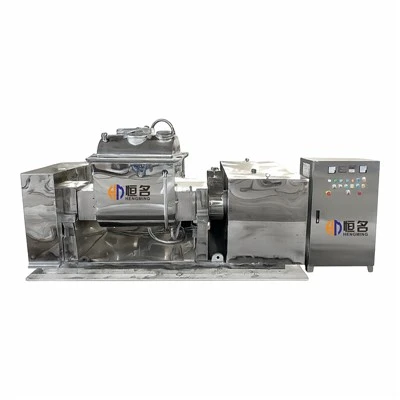
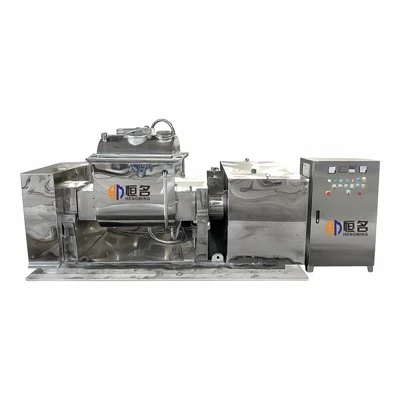
From the outside, this model is a compact twin-shaft kneader: polished chamber, rigid base and side drive with service space around it. The working zone stays enclosed while the selected heating, cooling or vacuum connections remain accessible.


Contained chemical mixing chamber
Before fabrication, we confirm shaft support, seal type, contact finish and utility ports against the chemical data sheet. Those decisions are shown on the production drawing and then checked again during PDI.
Product Qualification & Inspection Support
During PDI we can record shaft alignment, bearing temperature, seal arrangement, weld appearance, control response and the agreed contact-material record. CE/EMC examples are reference images; the shipped certificate and technical file must match the final configuration and destination market.


FAQ
Q: Can the chamber handle a corrosive or solvent-bearing formula?
A: Contact parts can be discussed in SUS304, SUS316L or another agreed material after we review the chemistry. Seal and surface choices are made from the actual formulation rather than a generic promise.
Q: How is vapour leakage reduced during kneading?
A: A rigid shaft line helps the mechanical seal keep its designed contact. We also confirm the seal type, cover and any vent or vacuum arrangement against the solvent and temperature data.
Q: What should we send for a chemical kneader quotation?
A: The useful starting information is viscosity, solids content, temperature, solvent or vapour concerns, batch size and discharge method. Those details let us size the drive and sealing package together.
For chemical processing, a stable shaft line is part of the containment strategy.
Hot Tags: chemical kneader, China chemical kneader manufacturers, suppliers, factory, compound kneader for drugs, dual sigma kneader, high performance kneader for batteries, high temperature kneader, Lithium Battery Materials Kneader, medicine kneading equipment