ceramic kneader
Product Introduction
Refractory mud and silicon carbide do not forgive a weak working surface. They load the blades with abrasive grit, and any loss of clearance can put metal into a batch that must later meet strict insulation or firing requirements.
This refractory kneading machine combines a rigid frame, high-torque transmission and material-specific blade treatment. The goal is straightforward: keep the hard batch moving while controlling wear where the material and metal meet.
Product Parameter (Specification)
|
Model |
Total Capacity (L) |
Working Capacity (L) |
Motor Power (KW) |
Blade Speed (RPM) |
Discharge Method |
Heating/Cooling Method |
|
NH/NHZ-0.25 |
0.25 |
0.3 |
0.55 |
48/36 |
Tilting Discharge |
Electric Heating / Steam Heating / Water-Cooled / External Circulation Heating/Cooling |
|
NH/NHZ-0.5 |
0.5 |
0.5 |
0.55 |
48/36 |
||
|
NH/NHZ-1 |
1 |
1 |
1.1 |
48/36 |
||
|
NH/NHZ-2 |
2 |
2 |
1.1 |
48/36 |
||
|
NH/NHZ-5 |
5 |
5 |
1.5 |
48/36 |
Tilting Discharge / Screw Extruding Discharge / Ball Valve Discharge / Custom Discharge |
|
|
NH/NHZ-10 |
10 |
10 |
2.2 |
48/36 |
||
|
NH/NHZ-20 |
20 |
14 |
4 |
48/36 |
||
|
NH/NHZ-50 |
50 |
35 |
7.5 |
40/30 |
||
|
NH/NHZ-100 |
100 |
70 |
11 |
36/24 |
||
|
NH/NHZ-200 |
200 |
140 |
15 |
36/24 |
||
|
NH/NHZ-300 |
300 |
210 |
22 |
36/24 |
||
|
NH/NHZ-500 |
500 |
350 |
37 |
36/24 |
||
|
NH/NHZ-1000 |
1000 |
700 |
55 |
36/24 |
||
|
NH/NHZ-1500 |
1500 |
1050 |
55 |
36/24 |
||
|
NH/NHZ-2000 |
2000 |
1400 |
75 |
32/22 |
||
|
NH/NHZ-3000 |
3000 |
2100 |
110 |
32/22 |
||
|
NH/NHZ-4000 |
4000 |
2800 |
160 |
30/20 |
||
|
NH/NHZ-5000 |
5000 |
3500 |
200 |
30/20 |
||
|
NH/NHZ-6000 |
6000 |
4200 |
200 |
30/20 |
||
|
NH/NHZ-7000 |
7000 |
4900 |
220 |
30/20 |
||
|
NH/NHZ-10000 |
10000 |
7000 |
300 |
30/20 |
||
|
The above parameters are for reference only, and specific parameters need to be adjusted according to the materials. |
||||||
Product Features & Application
The WEG motor and Guomao reducer are chosen for the resistance of the actual ceramic recipe, not simply for nominal tank volume. The drive is allowed to start firmly and keep turning through the dry, stiff portion of the cycle.
Blade hardness, coating or surface quenching can be discussed from the abrasive grade and contamination limit. Siemens speed control and Schneider/Chint protection give the operator a measured start rather than a shock load on the transmission.
When a recipe changes from powder-rich feed to a damp plastic mass, the operator can use a slower entry ramp and confirm blade clearance before the full charge is added.
Core Components & Features
For ceramic and refractory processing, a component list is also a wear-control plan. Each item below supports torque, alignment, speed handling or electrical protection that the batch demands.


WEG Motor
The WEG motor supplies the starting margin needed when a dry ceramic mass has not yet broken into a workable paste. Power selection is reviewed alongside moisture, density and batch size so the motor is not asked to cover an unknown load.
Guomao Gear Reducer
The Guomao reducer converts motor speed into the slower, forceful motion used by the overlapping blades. Its ratio and service factor are checked against abrasive duty and the expected start-stop pattern.
Siemens Inverter
Siemens speed control lets operators bring the batch into the shear zone gradually and change the recipe profile when the powder-to-binder ratio changes. A controlled ramp also helps reduce avoidable shock to the hardened blade set.
NSK Bearing
NSK bearings keep the shafts supported while abrasive material presses unevenly against the blades. Maintaining alignment protects the sealing area and helps hold the blade-to-chamber clearance that supports material purity.
Schneider Electrical Components
Schneider components give the control cabinet a dependable protection and switching base. Panel selection is matched to the local supply and to the high-current starting conditions of the ceramic batch.
Applications
These application examples focus on hard powders and pastes where wear, contamination and torque must be considered together. Material trials remain the final basis for blade treatment and surface selection.

Carbon & New Materials
Silicon-carbon blends, graphite-based mixes and other advanced powders can be kneaded with the torque and clearance discipline required by abrasive feedstock. The process team can review wear rate and purity before scaling the batch.

Laboratory & R&D
Small refractory trials benefit from a machine that exposes the same wear questions as production equipment. Researchers can compare binder ratios, blade treatment and mixing time without hiding the abrasive behaviour.

Chemical & Adhesive Materials
Filled chemical pastes and mineral-loaded binders may be less abrasive than ceramic mud but still need a strong shear zone. The specification can be adjusted after reviewing filler size, solids content and contact requirements.

Pharmaceutical Materials
Where a mineral excipient or ceramic-grade powder enters a controlled formulation, the discussion should cover cleanability and material purity as carefully as torque. The final contact finish and cleaning method are confirmed before order.
Production Details
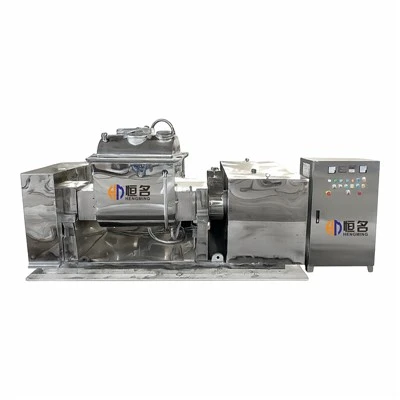
The machine exterior shows a fixed steel base, an enclosed mixing chamber and a side-mounted drive package. The layout keeps the heavy transmission low and gives the operator a clear view of the working and service zones.
Blade material, hardening method, clearance and dust-control details are agreed from the abrasive recipe. The production drawing then connects those choices to inspection access and the customer's batch-handling method.
Product Qualification & Inspection Support
PDI for a ceramic kneader should document the no-load run, bearing temperature, visible welds, blade finish and the agreed wear-treatment record. CE/EMC examples are shown for reference; certificates and technical files for the shipped machine must match its final model, electrical scope and destination requirements.


Delivery, Shipping and Service
After fabrication, the exposed carbon-steel surfaces are protected with industrial coating. The base is fixed to a steel transport frame, and the complete unit is braced inside a reinforced wooden crate. Packing photographs and a 12-month warranty support the handover, with video guidance available during installation.
FAQ
Q: How is metal pickup controlled in an abrasive ceramic batch?
A: We start with the material hardness and contamination limit, then select blade steel and a hardening or coating route. Clearance is checked during assembly so the blades do not rub the chamber.
Q: Can the kneader start with a low-moisture refractory mix?
A: The drive is sized from the recipe density, moisture and batch size. A WEG motor with a torque-matched reducer gives the shafts a stronger starting margin than a light-duty mixer.
Q: What information is needed for a wear-resistant blade proposal?
A: Send the powder or paste composition, particle hardness, moisture range and required batch volume. We will use those details to recommend blade treatment and a practical inspection plan.
Hot Tags: ceramic kneader, China ceramic kneader manufacturers, suppliers, factory, Ceramic Kneader, chemical mixing machine, Food Kneader, lithium battery kneader, Lithium Battery Materials Kneader, medicine kneading equipment