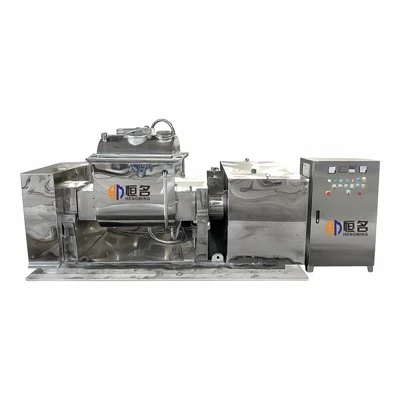
Hydraulic Tilting Discharge Kneader
Product Introduction
Some batches leave the chamber only after the operator has helped them out. With hot rubber or sticky chemical dough, that means waiting beside the machine and working near a heavy vessel. Here the independent hydraulic station moves the W-shaped chamber toward the selected 90-degree position; the operator can pause, line the opening up with a cart or bin, and return the vessel for cleaning.
Product Parameter (Specification)
|
Model |
Total Capacity (L) |
Working Capacity (L) |
Motor Power (KW) |
Blade Speed (RPM) |
Discharge Method |
Heating/Cooling Method |
|
NH/NHZ-0.25 |
0.25 |
0.3 |
0.55 |
48/36 |
Tilting Discharge |
Electric Heating / Steam Heating / Water-Cooled / External Circulation Heating/Cooling |
|
NH/NHZ-0.5 |
0.5 |
0.5 |
0.55 |
48/36 |
||
|
NH/NHZ-1 |
1 |
1 |
1.1 |
48/36 |
||
|
NH/NHZ-2 |
2 |
2 |
1.1 |
48/36 |
||
|
NH/NHZ-5 |
5 |
5 |
1.5 |
48/36 |
Tilting Discharge / Screw Extruding Discharge / Ball Valve Discharge / Custom Discharge |
|
|
NH/NHZ-10 |
10 |
10 |
2.2 |
48/36 |
||
|
NH/NHZ-20 |
20 |
14 |
4 |
48/36 |
||
|
NH/NHZ-50 |
50 |
35 |
7.5 |
40/30 |
||
|
NH/NHZ-100 |
100 |
70 |
11 |
36/24 |
||
|
NH/NHZ-200 |
200 |
140 |
15 |
36/24 |
||
|
NH/NHZ-300 |
300 |
210 |
22 |
36/24 |
||
|
NH/NHZ-500 |
500 |
350 |
37 |
36/24 |
||
|
NH/NHZ-1000 |
1000 |
700 |
55 |
36/24 |
||
|
NH/NHZ-1500 |
1500 |
1050 |
55 |
36/24 |
||
|
NH/NHZ-2000 |
2000 |
1400 |
75 |
32/22 |
||
|
NH/NHZ-3000 |
3000 |
2100 |
110 |
32/22 |
||
|
NH/NHZ-4000 |
4000 |
2800 |
160 |
30/20 |
||
|
NH/NHZ-5000 |
5000 |
3500 |
200 |
30/20 |
||
|
NH/NHZ-6000 |
6000 |
4200 |
200 |
30/20 |
||
|
NH/NHZ-7000 |
7000 |
4900 |
220 |
30/20 |
||
|
NH/NHZ-10000 |
10000 |
7000 |
300 |
30/20 |
||
|
The above parameters are for reference only, and specific parameters need to be adjusted according to the materials. |
||||||
Product Features & Application
Mixing and discharge are treated as two separate motions. WEG motor and Guomao reducer finish the knead; Siemens speed control brings the shafts to a controlled stop, while Schneider/Chint protection coordinates the mixer, hydraulic station and interlocks. Cylinder travel, lock position and receiving height are checked against the floor plan before fabrication.
Core Components & Features
Buyers usually ask two questions: will the drive finish the batch, and can the vessel move safely when it is full? The five components below answer those questions in order, from mixing torque and shaft support to the hydraulic and electrical controls.


WEG Motor
The WEG motor carries the mixing load before the vessel tilts. We review batch weight and resistance so the machine reaches discharge with a fully worked batch rather than a partially stalled one.
Guomao Gear Reducer
Guomao reducer gives the shafts the steady motion needed for dense dough. Its torque path is checked separately from the hydraulic cylinder capacity, keeping the mixing and tipping duties clear in the quotation.
Siemens Inverter
The Siemens inverter lets the operator set the kneading profile and bring the shafts to a controlled stop before the hydraulic station moves the vessel. That order makes the handover easier to check during a trial.
NSK Bearing
NSK bearings support the shafts while a dense batch presses on the blades and the vessel changes position. Alignment protects the seals and keeps rotation steady through mixing and discharge.
Schneider Electrical Components
Schneider components provide the electrical base for the mixer, hydraulic station and safety interlocks. We match the panel to the site voltage and to the pause, lock and restart logic agreed with the operator.
Applications
A hydraulic tilt is considered when the finished material is too heavy, sticky or viscous for a simple outlet. The examples below show where the vessel position and receiving equipment can be planned together.

Rubber & Plastics
Dense rubber and polymer compounds may leave a fixed vessel slowly and require repeated scraping. Tilting opens a broad, visible path into the next container and keeps the operator away from the moving mass.

Chemical & Adhesive Materials
Chemical doughs and high-viscosity adhesives can be moved with less scooping near the operator. Cylinder travel, seal protection and receiving height are set from the material and the plant layout.

Food Materials
A tilting chamber can recover a heavy food or confectionery batch when it will not fall through a small outlet. Sanitary surface, cleaning access and safe cart positioning are agreed before production.

Pharmaceutical Materials
For clean compounds that need controlled recovery, the tilt action can reduce manual contact with the batch. The final design still has to meet the customer's surface, seal and cleaning-validation requirements.
Production Details
The exterior view shows the polished chamber at its discharge position, with the hydraulic cylinders and base visible for inspection. The movement from mixing to collection is clear without hiding the service points.


Tilting discharge working position
Before fabrication, we confirm maximum angle, cylinder force, locking method, cart height and contact finish from the customer's floor plan. This keeps the 90-degree capability useful in the actual installation.
Product Qualification & Inspection Support
At PDI we can record mixer rotation, cylinder travel, pause and lock function, bearing temperature, weld appearance and the selected safety interlocks. CE/EMC documents are reference examples; final certificates and inspection records match the delivered configuration.


Delivery, Shipping and Service
The heavy base is coated, fixed to a steel skid and braced in reinforced timber for ocean transport. Loading photographs and installation-clearance notes help the receiving team plan the move. A 12-month warranty and remote commissioning support are included.
FAQ
Q: Can the vessel stop before reaching 90 degrees?
A: Yes. The independent hydraulic station can be specified to pause and hold the chamber at an intermediate position, subject to the agreed safety and locking arrangement.
Q: How do we match the tilt to our carts or bins?
A: Send the maximum batch weight, receiving height and available floor clearance. We will review cylinder travel, discharge opening and the final stopping position together.
Q: Does hydraulic tipping replace the need for a discharge valve?
A: Not always. The right choice depends on whether the material flows, how cleanly it must be recovered and what the next process accepts. We can compare both routes from the actual recipe.
Hot Tags: hydraulic tilting discharge kneader, China hydraulic tilting discharge kneader manufacturers, suppliers, factory, Bottom Valve Discharge Kneader, discharge type kneader mixers series, extrusion kneading equipment, Hydraulic Tilting Discharge Kneader, kneader mixer, screw extrusion mixer