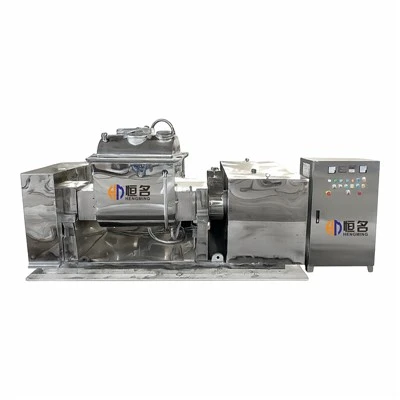
variable frequency kneader
Product Introduction
A fixed speed can be too aggressive at one point in a recipe and too weak at another. Shear-sensitive polymer chains may overheat while a stiff carbon paste still needs more torque, leaving the operator with no useful middle ground. This VFD kneader gives the drive a wider working range. The operator can start gently, slow the blades during a sensitive stage and bring back low-speed force when the material thickens, while the rigid frame absorbs the changing load.
Product Parameter (Specification)
|
Model |
Total Capacity (L) |
Working Capacity (L) |
Motor Power (KW) |
Blade Speed (RPM) |
Discharge Method |
Heating/Cooling Method |
|
NH/NHZ-0.25 |
0.25 |
0.3 |
0.55 |
48/36 |
Tilting Discharge |
Electric Heating / Steam Heating / Water-Cooled / External Circulation Heating/Cooling |
|
NH/NHZ-0.5 |
0.5 |
0.5 |
0.55 |
48/36 |
||
|
NH/NHZ-1 |
1 |
1 |
1.1 |
48/36 |
||
|
NH/NHZ-2 |
2 |
2 |
1.1 |
48/36 |
||
|
NH/NHZ-5 |
5 |
5 |
1.5 |
48/36 |
Tilting Discharge / Screw Extruding Discharge / Ball Valve Discharge / Custom Discharge |
|
|
NH/NHZ-10 |
10 |
10 |
2.2 |
48/36 |
||
|
NH/NHZ-20 |
20 |
14 |
4 |
48/36 |
||
|
NH/NHZ-50 |
50 |
35 |
7.5 |
40/30 |
||
|
NH/NHZ-100 |
100 |
70 |
11 |
36/24 |
||
|
NH/NHZ-200 |
200 |
140 |
15 |
36/24 |
||
|
NH/NHZ-300 |
300 |
210 |
22 |
36/24 |
||
|
NH/NHZ-500 |
500 |
350 |
37 |
36/24 |
||
|
NH/NHZ-1000 |
1000 |
700 |
55 |
36/24 |
||
|
NH/NHZ-1500 |
1500 |
1050 |
55 |
36/24 |
||
|
NH/NHZ-2000 |
2000 |
1400 |
75 |
32/22 |
||
|
NH/NHZ-3000 |
3000 |
2100 |
110 |
32/22 |
||
|
NH/NHZ-4000 |
4000 |
2800 |
160 |
30/20 |
||
|
NH/NHZ-5000 |
5000 |
3500 |
200 |
30/20 |
||
|
NH/NHZ-6000 |
6000 |
4200 |
200 |
30/20 |
||
|
NH/NHZ-7000 |
7000 |
4900 |
220 |
30/20 |
||
|
NH/NHZ-10000 |
10000 |
7000 |
300 |
30/20 |
||
|
The above parameters are for reference only, and specific parameters need to be adjusted according to the materials. |
||||||
Product Features & Application
The industrial VFD ramps the motor instead of applying a full across-the-line start. That reduces electrical disturbance and softens the twist delivered to the gears and shafts.
At low frequency the WEG motor and Guomao reducer continue to provide useful torque for thick rubber or carbon paste. Siemens control, NSK support and Schneider/Chint protection are combined with the in-house-machined frame and bearing housings.
Core Components & Features
Variable speed is most valuable when it changes a measurable process outcome. The component package below is linked to shear, energy, starting load and the recipe window rather than to a generic inverter claim.


WEG Motor
The WEG motor is selected to retain useful torque when the VFD slows the shaft for a stiff portion of the batch. The rating is checked with the low-frequency duty and the actual resistance of the formulation.
Guomao Gear Reducer
The Guomao reducer translates low-speed motor output into force at the blades. Ratio, cooling and service factor are reviewed with the speed range so the transmission remains comfortable at both ends of the recipe.
Siemens Inverter
The Siemens inverter is the operator's main tool for managing ramp, speed and repeatability. It can protect a sensitive stage, reduce unnecessary energy use and give the process engineer a controlled route back to torque.
NSK Bearing
NSK bearings support the shaft line against vibration, friction heat and the changing load caused by variable speed. Stable alignment keeps the seal and blade clearance predictable as the profile moves.
Schneider Electrical Components
Schneider electrical components provide protection and switching around the VFD cabinet. The panel is matched to the site grid, motor data and the alarms the operator needs to see during a long recipe.
Applications
A VFD pays back when the recipe has more than one useful speed. The application examples below show where shear control or low-speed torque can be part of the commercial result.

Rubber & Plastics
Rubber and polymer compounds can be softened with a controlled start and then worked at low speed as resistance builds. The operator has more room to protect the compound without losing the ability to push through a stiff stage.

Chemical & Adhesive Materials
Adhesives and chemical pastes often change viscosity as wetting or reaction proceeds. A variable profile lets the process follow that change instead of forcing every stage through the same shear rate.

Carbon & New Materials
Carbon pastes and filled binders are sensitive to dispersion energy and heat. Adjustable speed helps the team compare a gentle wetting phase with a stronger finish without changing the machine.

Laboratory & R&D
R&D work benefits from a machine that can map a speed window rather than deliver one point. The VFD gives the trial team a practical way to connect shear history with texture, temperature and energy.
Production Details
The inverter cabinet and heavy kneader frame show a clear separation between speed control and the enclosed working chamber. The visible layout keeps the panel serviceable while the drive base remains rigid.


Siemens inverter control cabinet
Frequency range, low-speed duty, motor cooling, bearing support and control signals are confirmed before fabrication. The result is a VFD package designed around the recipe, not simply a cabinet added to a fixed-speed mixer.
Product Qualification & Inspection Support
VFD-kneader PDI can include ramp and speed response, no-load rotation, bearing temperature, motor protection, panel inspection, visible welds and the agreed control signals. CE/EMC examples are reference material; final records follow the ordered electrical configuration.


Delivery, Shipping and Service
The steel frame and cabinet are protected, fixed to a skid and packed inside reinforced timber. We provide loading photographs, a 12-month warranty and remote support for parameter review and commissioning.
FAQ
Q: Why use a VFD for a shear-sensitive polymer?
A: It lets the operator choose a gentler speed where high shear would damage the formulation, then recover torque at low speed when the batch thickens. The useful profile depends on the recipe.
Q: Can variable speed reduce power use?
A: It can avoid running at full speed when the process does not need it. We review the duty cycle and motor data so the expected energy benefit is based on operation rather than a slogan.
Q: What should we provide for VFD sizing?
A: Send speed range, material viscosity, batch size, temperature, start condition and the phases of the recipe. Those details guide the inverter, motor and reducer selection.
Hot Tags: variable frequency kneader, China variable frequency kneader manufacturers, suppliers, factory, frequency controlled mixer, hydraulic kneading machine, motor reducer kneading machine, precision kneading machine, standard motor kneader, Variable Frequency Speed Control Kneader