rubber Kneader
Product Introduction
A rubber batch changes during the run. It may start tacky, take up filler, and then push hard against the blades. That is why the small NH/NHZ-20 entry uses a different motor duty from the 1,000 L class; capacity alone does not tell us how a grade will behave.
The most useful first discussion is not a catalogue size. We ask for the rubber grade, filler load, batch weight and target cycle, then compare those details with the working volume, shaft support, temperature circuit and outlet shown in the table.
Product Parameter (Specification)
|
Model |
Total Capacity (L) |
Working Capacity (L) |
Motor Power (KW) |
Blade Speed (RPM) |
Discharge Method |
Heating/Cooling Method |
|
NH/NHZ-0.25 |
0.25 |
0.3 |
0.55 |
48/36 |
Tilting Discharge |
Electric Heating / Steam Heating / Water-Cooled / External Circulation Heating/Cooling |
|
NH/NHZ-0.5 |
0.5 |
0.5 |
0.55 |
48/36 |
||
|
NH/NHZ-1 |
1 |
1 |
1.1 |
48/36 |
||
|
NH/NHZ-2 |
2 |
2 |
1.1 |
48/36 |
||
|
NH/NHZ-5 |
5 |
5 |
1.5 |
48/36 |
Tilting Discharge / Screw Extruding Discharge / Ball Valve Discharge / Custom Discharge |
|
|
NH/NHZ-10 |
10 |
10 |
2.2 |
48/36 |
||
|
NH/NHZ-20 |
20 |
14 |
4 |
48/36 |
||
|
NH/NHZ-50 |
50 |
35 |
7.5 |
40/30 |
||
|
NH/NHZ-100 |
100 |
70 |
11 |
36/24 |
||
|
NH/NHZ-200 |
200 |
140 |
15 |
36/24 |
||
|
NH/NHZ-300 |
300 |
210 |
22 |
36/24 |
||
|
NH/NHZ-500 |
500 |
350 |
37 |
36/24 |
||
|
NH/NHZ-1000 |
1000 |
700 |
55 |
36/24 |
||
|
NH/NHZ-1500 |
1500 |
1050 |
55 |
36/24 |
||
|
NH/NHZ-2000 |
2000 |
1400 |
75 |
32/22 |
||
|
NH/NHZ-3000 |
3000 |
2100 |
110 |
32/22 |
||
|
NH/NHZ-4000 |
4000 |
2800 |
160 |
30/20 |
||
|
NH/NHZ-5000 |
5000 |
3500 |
200 |
30/20 |
||
|
NH/NHZ-6000 |
6000 |
4200 |
200 |
30/20 |
||
|
NH/NHZ-7000 |
7000 |
4900 |
220 |
30/20 |
||
|
NH/NHZ-10000 |
10000 |
7000 |
300 |
30/20 |
||
|
The above parameters are for reference only, and specific parameters need to be adjusted according to the materials. |
||||||
Product Features & Application
The WEG motor and Guomao reducer form the main drive. On the smaller entries, blade speed is listed as 48/36 rpm; the larger units step down to 30/20 rpm. Overlapping blades return material to the working zone, while the four NSK bearing positions support the shafts when a dense batch pushes sideways.
- Most rubber recipes have a softer start and a harder middle. Siemens speed control lets the operator move between those stages. Schneider and Chint protection are selected for the panel and site supply, and the heating, cooling and discharge choices are tied to the material trial rather than copied from a different batch.
- On a grade change, the operator can wet the polymer first and bring in filler in the agreed order. That sequence gives us something practical to review: the thermal connection, the outlet position and the time needed to clear the chamber.
- Watch how the batch behaves near the end of the cycle. A matched speed range gives the operator room to slow a difficult start or add working intensity later, instead of forcing every grade through one setting.
Core Components & Features
A plant manager usually asks three things. Will the drive get through the difficult part? Can the maintenance team reach the seals and bearings? Can the next batch be started without guessing? We use the material information and the machine table to answer those questions before issuing a quotation.


WEG Motor
WEG motor capacity is checked at the full-chamber, high-resistance point. That is where starting margin earns its keep; a motor selected only from the average load can look fine on paper and still disappoint at the start of a dense batch.
Guomao Gear Reducer
The Guomao reducer sets the blade force and speed used for folding and shearing. Ratio and service factor are reviewed with batch weight, cycle target and thermal duty before the drive is confirmed.
Siemens Inverter
With the Siemens inverter, one recipe can have a slower wetting stage and a different working stage. Operators can record those two steps for a grade change rather than re-tuning a fixed-speed machine by feel.
NSK Bearing
The four NSK bearing positions carry the side load from a resistant rubber batch. Good alignment helps protect the seals and holds blade clearance, so the force from the drive reaches the material instead of being lost in shaft movement.
Schneider Electrical Components
Schneider components give the panel a familiar switching and protection platform. We match the final selection to the local grid and to the customer's normal spare-parts and service routine.
Applications
The same kneader may see natural rubber on one shift and a filled polymer on the next. We begin an application review with the grade, filler, batch size and throughput, then use the trial result to settle the final settings. The table remains a reference, not a promise of one universal recipe.

Rubber & Plastics
Natural and synthetic rubber, filled elastomers and plastic additives all become more resistant as the mass develops. The drive, temperature circuit and outlet can be arranged around the mill or extruder that receives the batch.

Chemical & Adhesive Materials
Rubber adhesives and tacky chemical mixes need firm folding without letting the working temperature drift outside the formulation window. Seal material, contact finish and outlet details are checked with the formulation before the build is released.

Carbon & New Materials
Carbon black, graphite and similar fillers can make a polymer batch unexpectedly hard to turn. Blade overlap and the selected speed profile help pull filler into the carrier while the operator keeps control from the panel.

Toy & Creative Materials
Modelling compounds, colour masterbatches and specialty polymer pastes are often made in smaller lots. The heavy-duty frame gives those batches useful reserve, while batch size and discharge height can be set for the workshop's actual throughput.
Production Details
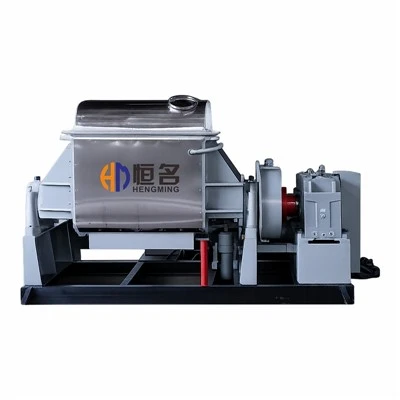
The product view shows the parts a buyer will see on the floor: a steel base, an enclosed W-shaped chamber and a side-mounted drive. There is working access around the rotating and sealing areas for inspection and cleaning between grades.


Rubber kneader production configuration
Before fabrication, we put the agreed rubber grade and batch weight beside the motor power, bearing layout, blade clearance, thermal connections and outlet. For example, the 100 L entry shows 70 L working capacity and an 11 kW motor; the selection still has to be checked against the actual compound.
Product Qualification & Inspection Support
Before shipment, the rubber-kneader PDI can include a drive run, bearing-temperature check, blade and chamber inspection, weld appearance, control response and the specified heating or discharge connections. The record follows the delivered build.


Delivery, Shipping and Service
After PDI, the coated frame is fixed to a steel skid and protected in reinforced timber for ocean transport. Loading photographs and installation notes help the receiving crew plan the move. A 12-month warranty and remote technical support are included.
FAQ
Q: Can the kneader run through a dense rubber start?
A: We size the drive from rubber grade, batch weight, moisture and target speed, then check the WEG motor and Guomao reducer at the high-resistance start. The average cycle load is only one part of that decision.
Q: How do the bearings affect rubber-kneader life?
A: Supported shafts hold alignment while the rubber pushes radially against the blades. That helps protect seals and blade clearance. Bearing temperature and condition can also be added to the plant's preventive-maintenance checks.
Hot Tags: rubber kneader, China rubber kneader manufacturers, suppliers, factory, high efficiency kneader, industrial kneader, Z type batch mixer